

Eroding Judgement, Reflecting, ... and more!
This Week on SalesTV
In This Newsletter
On Our Mid-Day Edition
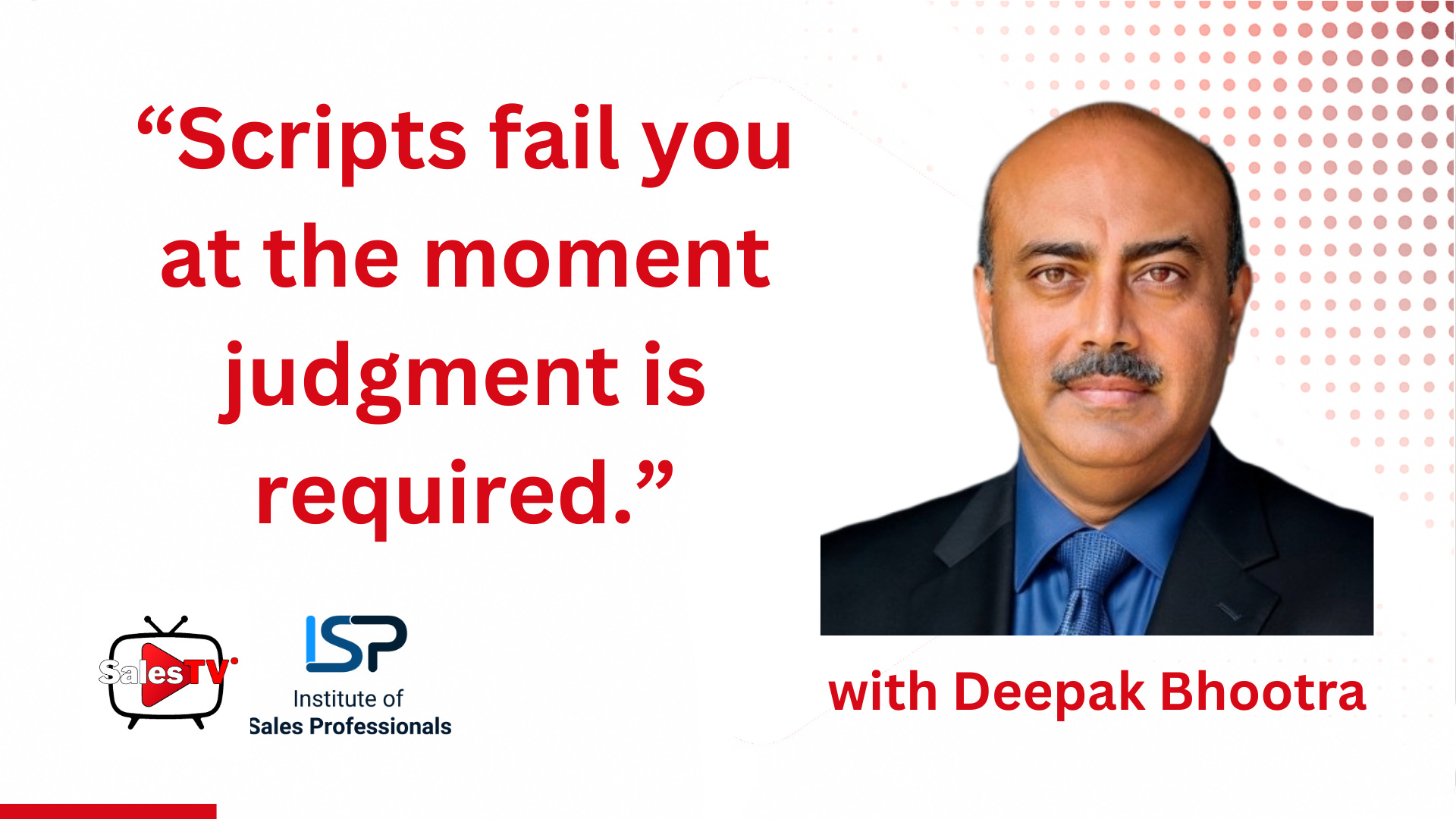
Here are some key takeaways from the episode:
Scripts and Automation Can Erode Judgment
Deepak highlighted that while scripts and automation tools can initially create structure, overreliance on them causes sellers to lose the ability to read the situation and apply real-time judgment - especially since buyers aren’t following the same script. He emphasized that true trust with customers comes from being present and adjusting to the conversation in the moment, not from memorized lines or automated actions.
Fix Fundamentals Before Automating
According to Deepak, automating broken sales processes only “scales stupidity.” He advised that leaders and sellers should first ensure their underlying systems, communication strategies, and core behaviors are strong and effective before layering on automation, as otherwise technology simply makes ineffective practices faster.
Sell the Future, Not Just Numbers
Deepak stressed that the best salespeople focus less on quotas or numbers and more on painting a compelling vision of the future for their clients. By anchoring conversations around the customer’s desired outcomes and the possibilities ahead, sellers create more motivation and sustainable behaviors - rather than driving short-term fixes or stress associated with numeric targets.
Tools Are Only as Good as the Wisdom Guiding Them
Deepak cautioned that an overabundance of tools and AI-driven insights can create confusion and misdirection if not guided by human expertise and discipline. He advised sales leaders and teams to prioritize meaningful conversation, pattern recognition, and customer-centric language over a fixation on data points or tool-driven “microfictions.”
Make AI Your Augmented Intelligence, Not a Crutch
Deepak advocated for using AI as “augmented intelligence,” where technology supports and enhances human decision-making rather than replacing it. He encouraged professionals to leverage AI to expand their thinking and test their strategies, while keeping themselves at the center of sales conversations and human judgment as the decisive factor.
You can listen to the episode here
You can watch the episode here
More Insights from our Mid-Day Edition Guest
A Guest Reflection
Modern sales have never been better equipped. We have scripts for every scenario, plays for every stage, dashboards for every conversation, and automation to remove friction from almost every task. And yet, many sales leaders and experienced sellers quietly feel something slipping away. Conversations feel thinner. Adaptability feels slower. Judgment feels dulled.
This is not a technology problem. It is a mindset problem that crept in gradually.
When Tools Reduce Thinking Instead of Supporting It
Sales tools are designed to reduce cognitive burden. They standardize language, suggest next steps, and create repeatability. All of this is helpful until we stop asking what happens to thinking when effort is no longer required.
Self-reflection for the reader:
When was the last time you had to pause in a sales conversation and genuinely think without a framework guiding you?
Do your tools force interpretation or reward execution?
Are your sellers forming hypotheses about buyers, or are they simply following instructions?
Judgment is built through effort, uncertainty, and discomfort. When tools remove friction, they also remove the moments where discernment develops. Over time, sellers stay busy but become less perceptive. They execute well but adapt poorly. The risk is not that tools exist. The risk is that they quietly replace the need to think.
When Data Feels Comforting but Moves Us Further from Reality
Data creates confidence. Dashboards feel clean. Forecasts feel controlled. In uncertain environments, this comfort is deeply seductive.
Self-reflection for the reader:
Do your numbers help you understand reality, or do they make it feel manageable?
When data conflicts with intuition or field experience, which one wins?
Are metrics opening better conversations or shutting them down?
Data often describes the past, while selling happens in the present. When numbers become the authority rather than an input, curiosity fades. Teams begin managing representations of reality instead of reality itself. This is where culture and structure matter more than strategy. If truth feels risky and compliance feels safe, data quality degrades, and judgment disappears.
The Shift Being Asked of Sales Leaders
This is not a call to abandon tools, scripts, or automation. It is a call to recenter judgment.
Use tools to surface questions, not answers.
Design structures that force thinking before execution.
Reward honest conversations over clean dashboards.
Slow down deal reviews to focus on human progression, not just stage progression.
Automation should scale execution. Judgment must remain human. The future of effective selling belongs to leaders who are willing to trade a little comfort and certainty for clarity, discernment, and better decisions.
That is the mindset shift being asked of us now.
Happy selling!!
Dr. Deepak Bhootra brings over 30 years of global sales and sales operations experience, including senior leadership roles at HP and Capgemini.
Beyond the Mid-Day Edition
The Future of Sales Belongs to People Who Can Think
This week’s “Beyond the Mid-Day Edition” insights are from our host Rob Durant
“I am not anti-automation. I am pro-judgment.”
— Dr. Deepak Bhootra
The Uncomfortable Reality
Sales hasn’t lost relevance. It’s lost thinking time.
Scripts, dashboards, and AI outputs promise clarity, but too often they remove the very pause that judgment requires. Friction has been engineered out of the process, and with it, the space to interpret, question, and decide. Efficiency is celebrated, even as it quietly erodes effectiveness.
Sales professionals aren’t overwhelmed by work, nor are they failing to keep up with the pace of business. They’re overwhelmed by how little room there is left for humanity in the process. And yet, it’s precisely that humanity - context, empathy, discernment - that still moves buyers and closes gaps no tool can.
Judgment Is the Differentiator Now
Judgment used to be assumed. Now it’s rare. And that makes it valuable.
AI can generate language, but it cannot own consequences. Automation can optimize tasks, but it cannot decide when a plan no longer fits reality. Buyers don’t reward speed. They reward relevance. And relevance only exists in context.
Judgment is what separates experienced professionals from compliant operators. When plans break - and plans always break - it’s comprehension, flexibility, and situational awareness that carry the day.
As Mike Tyson put it, “Everybody has a plan until they’re punched in the mouth.”
Sales is no different.
Augmented Intelligence vs. Abdicated Thinking
We have access to the most powerful tools the profession has ever seen. The danger isn’t using them. The danger is surrendering agency to them.
AI should orbit the human, not replace them. Use it to challenge your thinking, not outsource it. Let tools surface options - but let people choose direction. When professionals stop deciding and start deferring, judgment atrophies. And when judgment disappears, so does trust.
The risk isn’t that AI will take sales jobs. The risk is that salespeople will surrender agency.
What This Means for the Profession
The future of sales won’t be decided by better tools or faster workflows. It will be shaped by those who can still think clearly, ask better questions, and decide under pressure. It will be decided by those who can take information, apply judgment, and stand behind the decision.
Sales has always been a thinking profession.
The next era will reward those who still treat it that way.
Rob Durant is the CEO of US Operations for the Institute of Sales Professionals.
Son of a math teacher, Rob often says he too is a teacher at his core.
Coming up on SalesTV
On Our Next Mid-Day Edition
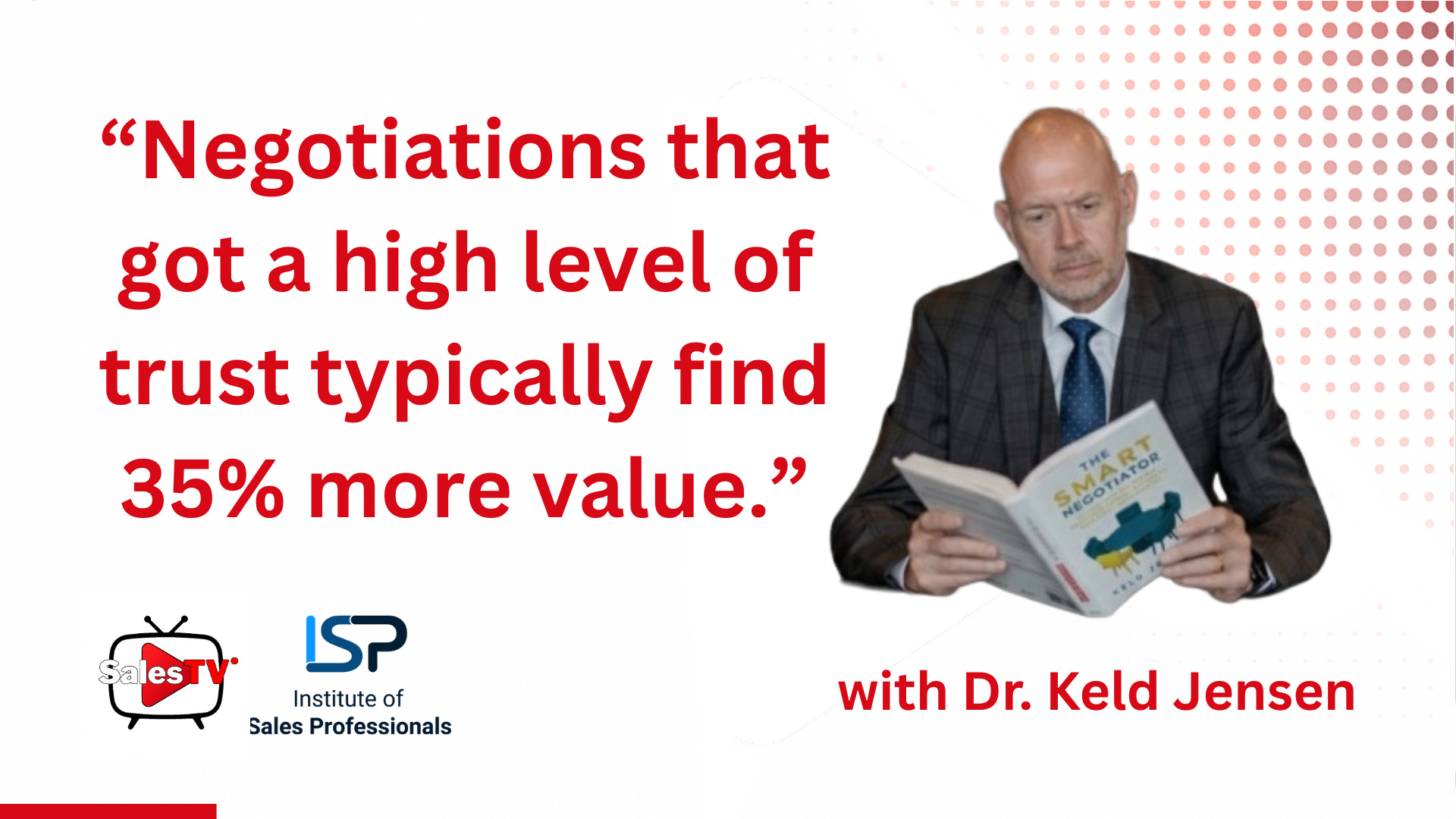
The Business Case for Trust in Sales Negotiations
Trust is one of the most discussed yet least quantified elements in sales negotiation. Often treated simply as a soft skill, research increasingly shows that trust has direct economic consequences.
In this episode of SalesTV, we explore how trust fundamentally changes negotiation outcomes - not in theory, but in measurable results. Dr. Keld Jensen, one of the world’s most awarded negotiation strategists, shares evidence showing how high-trust negotiations consistently outperform low-trust ones.
Drawing on decades of research and real-world negotiation data, we examine why traditional win-lose approaches persist, what they cost sales professionals over time, and how emerging tools like AI are reshaping preparation and transparency, without sacrificing rigor, preparation, or commercial discipline. This conversation reframes trust as a practical lever for creating more value at the table, especially in professional sales contexts where long-term relationships and credibility matter.
We’ll ask questions like -
* How do we build trust without weakening our negotiating position?
* How early in the sales process is trust really formed?
* How should sales leaders coach trust-based negotiation skills?
* How does AI influence transparency and trust in negotiations?
Dr. Keld Jensen is a globally recognized negotiation expert, researcher, and author with more than 30 years of experience in international negotiation, leadership, and education. He holds a doctorate focused on negotiation, trust, and AI. Author of 27 books published worldwide, including his most recent release, “The Smart Negotiator: Unlocking the Power of AI and Human Insight in Effective Deal-Making,” he has advised organizations across more than 50 countries on trust-based value creation in complex negotiations.
Trust-based negotiation, ethical sales practices, and collaborative negotiation models are increasingly central to professional selling. Research into negotiation economics shows that trust impacts preparation quality, information sharing, transparency, and long-term value creation. As sales environments grow more complex and digitally mediated, understanding how trust interacts with technology, negotiation strategy, and professional standards is becoming a core competency for experienced sales professionals and leaders.
Join us live! Tuesday, January 20, 2026, Noon ET / 9:00am PT ← Update date and link
#SmartNegotiator #SalesNegotiation #NegotiationSkills #NegotiationSkills
#Sales #SalesLeadership #LinkedInLive #Podcast
Where else can you find us?


